
Controlled Substance Disposal: Your Compliance Questions Answered
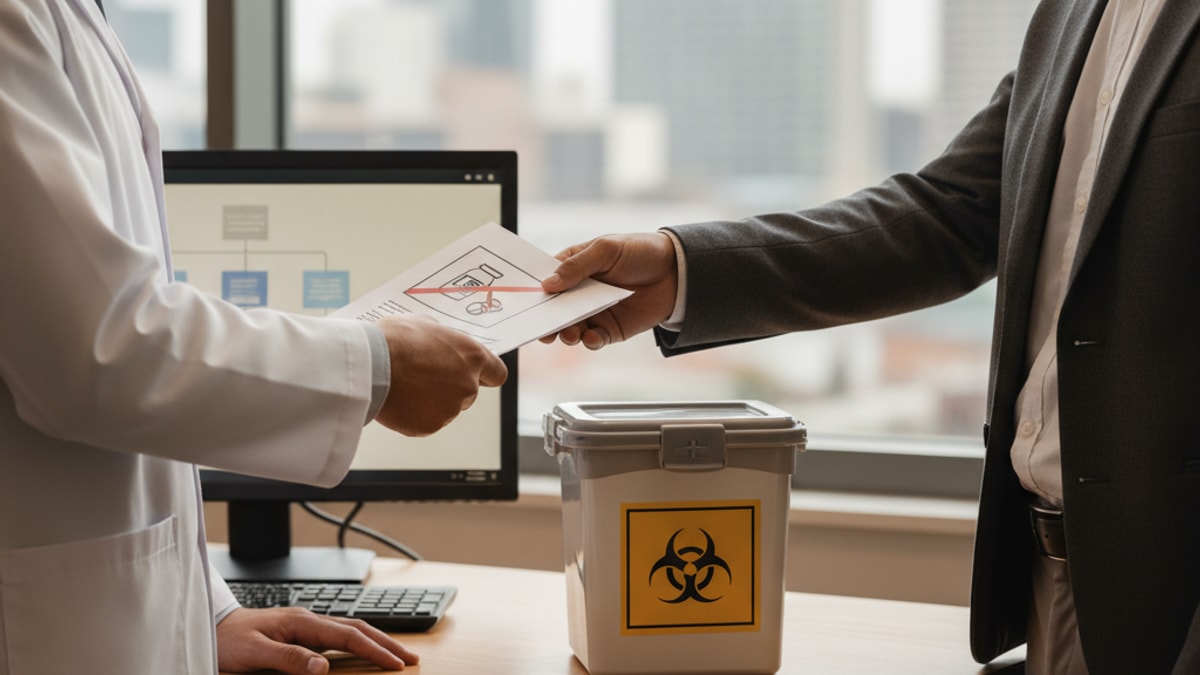
Let's be direct. Figuring out how to dispose of controlled substances is one of the most high-stakes, anxiety-inducing tasks a healthcare facility faces. It’s not just about getting rid of expired or unused medications; it's a labyrinth of federal regulations, meticulous documentation, and catastrophic risk. One misstep, one poorly documented transfer, one moment of procedural carelessness can bring the full weight of the Drug Enforcement Administration (DEA) down on your practice. And we've seen it happen.
Our team at Remedi has spent years navigating the complexities of medical waste, and we can tell you this with absolute certainty: controlled substance disposal is not an area for guesswork or corner-cutting. The potential for diversion—theft for illicit use—is a public health crisis, and the DEA's enforcement is, rightly so, relentless. This isn't just about avoiding fines. It's about protecting your community, your staff, your license, and the very integrity of your organization. It's a critical, non-negotiable element of modern healthcare operations.
Why Proper Disposal Isn't Just a Suggestion—It's the Law
When we talk about the rules governing controlled substances, we're primarily talking about the DEA. Their mandate is clear: prevent the diversion of these powerful medications. Every regulation, every form, every protocol is designed to create an unbreakable chain of custody from creation to destruction. The goal is to ensure that a Schedule II opioid prescribed in your clinic doesn't end up on the street. It’s that serious.
Improper disposal is viewed as a direct threat to that mandate. Flushing medications can contaminate water supplies, creating an environmental hazard with far-reaching consequences. Tossing them in the trash—even in a red bag destined for a biohazardous waste stream—is a direct invitation for diversion. These aren't just theoretical risks. They're realities that lead to devastating outcomes.
The consequences for non-compliance are severe. We mean this sincerely: they can be practice-ending. We're talking about fines that can easily climb into the tens or even hundreds of thousands of dollars, the suspension or outright revocation of a provider's DEA registration (and thus their ability to prescribe), and in the most egregious cases, criminal prosecution. The DEA doesn't make idle threats. Their record-keeping requirements are absolute, and their audits are unflinching. Your disposal process must be impeccable.
That’s the reality. It all comes down to risk mitigation and public safety.
Understanding DEA Schedules: Not All Drugs are Created Equal
To properly manage disposal, you first have to understand what you're dealing with. The DEA categorizes controlled substances into five "schedules" based on their accepted medical use and their potential for abuse or dependency. This classification is the bedrock of controlled substance regulation.
- Schedule I: High potential for abuse, no currently accepted medical use (e.g., heroin, LSD). These are typically only found in research settings.
- Schedule II: High potential for abuse, which may lead to severe psychological or physical dependence (e.g., oxycodone, fentanyl, morphine, methadone).
- Schedule III: Moderate to low potential for physical and psychological dependence (e.g., ketamine, anabolic steroids, testosterone).
- Schedule IV: Low potential for abuse and low risk of dependence (e.g., Xanax, Valium, Ambien).
- Schedule V: Lowest potential for abuse, contain limited quantities of certain narcotics (e.g., cough preparations with less than 200 milligrams of codeine).
Why does this matter for disposal? Because the DEA's scrutiny, especially regarding documentation and witness requirements, intensifies dramatically for Schedule II drugs. While all controlled substances require compliant disposal, a mistake with a bottle of expired Vicodin carries far more weight than an error with a Schedule V cough syrup. Knowing the schedule of every controlled substance in your inventory is the first step toward building a compliant disposal protocol.
The Most Common (and Dangerous) Disposal Mistakes We See
Our experience shows that most compliance failures aren't born from malicious intent. They come from misinformation, outdated practices, and a simple underestimation of the complexity involved. Here are the most frequent and perilous mistakes our team encounters when new clients come to us for help.
First, the old habit of flushing. For decades, it was common practice. We now know this is an environmental disaster in the making. Wastewater treatment facilities are not designed to filter out complex pharmaceutical compounds, which then enter our ecosystems, affecting wildlife and potentially re-entering human water supplies. The FDA and EPA are both adamant: do not flush controlled substances unless explicitly stated on the labeling (which is exceptionally rare).
Second is the trap of the wrong bin. It's a common assumption: "It's medical waste, so it goes in the red bag, right?" Wrong. So very wrong. Tossing controlled substances into a standard biohazard or sharps waste container is a direct violation and a massive diversion risk. Those waste streams are not subject to the same strict chain-of-custody and security protocols. It essentially leaves a highly abusable substance in an unsecured container, accessible to anyone along the waste stream path before final treatment.
Then there's the paperwork problem. This is a big one. The DEA requires meticulous, flawless record-keeping for every milligram of a controlled substance. The ultimate document is DEA Form 41, the "Registrants Inventory of Drugs Surrendered." This form documents exactly what was destroyed, when, how, and by whom. Inadequate, incomplete, or missing records are one of the fastest ways to fail a DEA audit. It's not enough to destroy the drug; you have to prove you destroyed it in a compliant manner. The paper trail is just as important as the physical disposal.
Finally, there's the human element. Proper disposal requires witnesses. The DEA generally mandates that two authorized employees personally witness the act of rendering a substance non-retrievable or placing it into a collection receptacle. Using a single person, or an unauthorized employee like a janitor or administrative assistant without proper clearance, invalidates the entire process from a compliance standpoint. It's a simple rule, but one that is surprisingly easy to get wrong in a busy clinical environment.
The DEA-Compliant Methods for Disposing of Controlled Substances
So, you can't flush them, and you can't trash them. What are you supposed to do? The DEA outlines a few acceptable paths, but our team has found that for the vast majority of healthcare facilities, one option provides vastly superior security and peace of mind. Let's break them down.
On-Site Destruction
This involves a facility destroying its own controlled substance waste on its premises. To be compliant, the method used must render the substance "non-retrievable." This is a very high standard. It means the substance must be permanently and irreversibly altered, so it cannot be extracted or transformed back into a usable form. This is far more than mixing pills with coffee grounds or kitty litter—an old, now non-compliant practice. It typically requires specific chemical digestion products or methods of encapsulation. While this method gives a facility direct control, it also saddles them with immense liability. The burden of proof, the meticulous documentation, and the risk of improper execution fall entirely on your shoulders. It requires significant staff training and a deep understanding of the regulations.
Mail-Back Systems
These systems provide containers that facilities can fill with waste controlled substances and then mail to a licensed destruction facility. They can be a convenient option for practices that generate very small, infrequent amounts of this type of waste. However, our experience shows they have limitations. You're still responsible for the internal handling, documentation, and proper packaging. And once it leaves your hands, you're trusting a third-party shipping service with a package of highly regulated substances, which can introduce chain-of-custody complexities.
Partnering with a DEA-Registered Reverse Distributor
This is, without question, the gold standard for safety, compliance, and liability protection. A reverse distributor is a company, like Remedi, that is registered with the DEA to handle and destroy controlled substances on behalf of healthcare facilities. The process is secure and straightforward. We provide specialized, tamper-evident containers for you to collect the waste. Our trained technicians then collect these containers, transport them in secure vehicles, and manage the entire witnessed destruction process at a licensed facility. We handle the DEA Form 41 and provide you with all the necessary certificates of destruction. This method effectively transfers the most significant portion of the risk and liability from your facility to ours. It's the core of our comprehensive controlled substance disposal service, and it’s the solution we recommend for any facility that prioritizes absolute, ironclad compliance.
Here’s a simple breakdown of how these methods stack up:
| Method | Compliance Risk | Convenience | Documentation Burden | Best For |
|---|---|---|---|---|
| On-Site Destruction | High (if done incorrectly) | Low | Very High | Facilities with dedicated, highly trained compliance staff and resources. |
| Mail-Back System | Moderate | High | Moderate | Very small quantity generators, such as a remote dental office or specialty clinic. |
| Reverse Distributor (like Remedi) | Very Low | Very High | Low (Handled by partner) | Most healthcare facilities seeking guaranteed compliance and liability protection. |
The Critical Role of Documentation and Chain of Custody
We can't stress this enough: in the eyes of the DEA, if it wasn't documented, it didn't happen. The physical act of destruction is only half the battle. The other half is creating an unimpeachable, cradle-to-grave record of every single controlled substance that enters and leaves your facility.
This process starts the moment a drug is received and continues through its entire lifecycle. When a substance is identified for disposal (perhaps it's expired, contaminated, or a partial dose from a single-use vial), it must be logged and stored securely, separate from active inventory. The transfer to a disposal container must be logged. The final destruction must be logged on DEA Form 41.
This form is the linchpin of your disposal records. It requires precise information: the name, strength, and form of the drug; the exact quantity; and the signatures of two authorized employees who witnessed the disposal. Any errors, omissions, or illegible entries can be a red flag during an audit. This is precisely where partnering with a specialist like Remedi becomes so valuable. Our process is designed around creating perfect documentation. We manage the final Form 41 submission and provide you with a certificate of destruction that serves as your proof of compliance, effectively closing the loop on your liability. It transforms a complex, high-risk administrative burden into a simple, streamlined, and fully documented process.
What Does "Rendered Non-Retrievable" Actually Mean?
This is one of the most misunderstood phrases in the DEA's regulations, and it's where many well-intentioned on-site disposal efforts fail. The DEA defines it as a method that permanently alters the substance's physical or chemical condition through irreversible means, rendering it unavailable and unusable for all practical purposes.
That's a mouthful. Let's be honest, it's a bit vague. Here's what it means in practice: you can't just crush up pills and mix them with water. You can't just blend them with something unpalatable like coffee grounds. A determined individual could, with relative ease, separate the active ingredient back out. The standard today requires a process, usually chemical, that breaks down the active pharmaceutical ingredient (API) itself. This is often achieved with chemical digestion pouches or liquid solutions that contain activated carbon or other denaturing agents. The substance must be fundamentally changed and destroyed.
Because the DEA doesn't approve or certify specific products, the onus is on the registrant (your facility) to prove that your chosen method meets this formidable standard. It’s a significant scientific and legal burden. This ambiguity is another powerful reason why outsourcing destruction to a specialized vendor who uses verified, industrial-scale technologies is the safest and most defensible strategy. We take on the burden of proving the method is compliant, so you don't have to.
Training Your Team is a Non-Negotiable Element
Your disposal protocols are only as strong as the weakest link in your team. You can have the best containers and the most robust documentation system, but if a single employee doesn't understand the rules, the entire process can be compromised.
Every single person who may come into contact with controlled substances needs to understand their role and responsibilities. This includes clinicians who administer the drugs, nurses who may be responsible for wasting partial doses, and pharmacy staff who manage inventory. They need to know what to do, what not to do, and who to ask when they're unsure. This isn't a one-time onboarding task; it's a commitment to ongoing education.
This is why we see compliance as a holistic endeavor. It’s not just about waste pickup; it’s about creating a culture of safety and awareness. That’s why, in addition to our disposal services, we offer comprehensive OSHA & HIPAA Compliance training solutions. A well-trained team is your first and best line of defense against the kinds of simple human errors that can lead to catastrophic compliance failures.
Ultimately, managing controlled substance disposal is a profound responsibility. The risks are too high, the regulations too complex, and the consequences of failure too severe to leave to chance. It requires a strategic, professional, and well-documented approach. By understanding the regulations and partnering with an expert who can navigate the process on your behalf, you're not just ensuring compliance—you're protecting your patients, your practice, and your peace of mind. If you're ready to build an ironclad disposal strategy, our team is here to help. Get Started Today.
Frequently Asked Questions
Can we just flush expired controlled substances down the toilet?
▼
Absolutely not. Flushing pharmaceuticals, especially controlled substances, contaminates water supplies and poses a significant environmental risk. This practice is strongly discouraged by both the EPA and FDA and is not a compliant disposal method.
What is DEA Form 41 and why is it so important?
▼
DEA Form 41, the ‘Registrants Inventory of Drugs Surrendered,’ is the official document used to record the destruction of controlled substances. It provides the DEA with a detailed record of what was destroyed, when, and by whom, serving as your primary proof of compliant disposal.
Do we really need two people to witness the disposal?
▼
Yes. The DEA generally requires that the process of destroying a controlled substance or placing it into a disposal container be witnessed by at least two authorized employees. This ‘two-person rule’ is a critical safeguard against diversion.
What’s the difference between pharmaceutical waste and controlled substance waste?
▼
While all controlled substances are pharmaceuticals, not all pharmaceuticals are controlled. Controlled substance waste is a subcategory that is strictly regulated by the DEA due to its potential for abuse, requiring a much higher level of security and documentation for disposal.
Can I put unused controlled substances into my sharps container?
▼
No, never. Sharps containers are for biohazardous sharps waste only and do not meet the security or chain-of-custody requirements for controlled substances. Co-mingling this waste is a serious compliance violation.
What does the DEA term ‘non-retrievable’ actually mean?
▼
A substance is rendered ‘non-retrievable’ when its physical or chemical state is permanently and irreversibly altered, making it unusable for its original purpose. This is a very high standard that simple mixing with coffee grounds or water does not meet.
How often should our facility dispose of accumulated controlled substance waste?
▼
There is no exact timeline mandated by the DEA, but waste should not be stockpiled indefinitely as this increases the risk of diversion. We recommend establishing a regular disposal schedule with a licensed partner based on the volume you generate.
Is a mail-back kit a compliant solution for our clinic?
▼
Mail-back kits can be compliant for facilities generating very small, infrequent amounts of waste. However, for most practices, a full-service reverse distributor offers a higher level of security, liability protection, and more robust chain-of-custody documentation.
What are the real penalties for improper disposal?
▼
The penalties are severe and can include substantial monetary fines, loss or suspension of a practitioner’s DEA registration, and even criminal charges in cases of significant negligence or diversion. It’s a risk no healthcare facility can afford to take.
How does a DEA-registered reverse distributor work?
▼
A reverse distributor, like Remedi, is licensed to take custody of your controlled substance waste. We provide secure collection containers, manage the secure transport, and oversee the witnessed, compliant destruction, providing you with all necessary documentation.
Do these disposal rules also apply to veterinary clinics?
▼
Yes, they do. Veterinarians are DEA registrants who prescribe and dispense controlled substances, and they are subject to the exact same storage, inventory, and disposal regulations as human healthcare providers.
How should we handle liquid controlled substances for disposal?
▼
Liquid controlled substances must also be rendered non-retrievable. This is often accomplished by using a special solidifying agent or a chemical digestion pouch that absorbs the liquid and denatures the active ingredients before disposal.